Showing posts with label Design. Show all posts

Sunday, March 8, 2026

My long‑awaited DuBach re‑do has begun

The long‑awaited re‑do of DuBach is officially underway, and today marked the first real step into this next chapter. I focused on the stretch from the bog heading north, through the curve that leads into the south end of El Dorado. It’s a satisfying way to kick things off—if also a little destructive. There’s something about ripping out old track that feels like a true point of no return, the moment when the commitment becomes real.

Back on November 10th, 2025, I said it was time to completely rebuild DuBach. Now that the work has started, that decision feels even more justified. This will be the third—and hopefully final—time this section gets a full overhaul. After operating the layout many times over several years, you learn what works, what doesn’t, and what quietly drives you crazy every session. Things evolve. Ideas mature. Standards rise.

This redo will be my chance to get it right, third times a charms, right? With the old track now pulled up, there’s no turning back. And honestly, that feels pretty great.


Not more than a few hours after the last bit of track was ripped up, I got an email. Every year, the local train show rolls into town like clockwork - a weekend of diesel fumes, nostalgia, and more N‑scale temptation than my wallet can reasonably withstand. But this year, the show comes with a twist. When it arrives a small crowd of friends who’ve all said the same fateful words:

“Hey, while we’re in town, we’d love to operate your layout.”

And just like that, the sword was hung over my head.


Sunday, November 16, 2025

Starting to rough out Cajun Hydraulics

In the last post I laid out the new plans for DuBach, LA. and also mentioned adding a new industry:  Cajun Hydraulics.  They are a manufacturer of Hydraulic hoses. This came about as I picked up a few of  the Carbon Black hoppers that came out a few years ago from Scale Trains.   

As most know who follow my blog, my layout is more or less a freelance design of the Little Rock and is meant to give the flavor of the line and not represent it prototypically.

After picking up those hoppers, and knowing I wanted to redo DuBach, it was time to see if I could get it to fit.  The first thing I needed to do was to make it served by the NB local and keep the placements of the current spurs designed to use the proper trailing point spurs so that I didn't have to go back and redesign the Ops in JMRI.

Luckily I was able to move A&A Cement and ARKLA Plastics to new locations while keeping the same trailing point turnouts proper, thus not making me redo the Ops plan.  Where A&A Cement was recently located, was actually a double ended siding that was used back in the day to store a few cars when the Ops were different.  I plan to remove the turnout from the left end of that rear siding (just right of the Bog) and use the right turnout after I move it to the left a bit.

With the location set, I wanted the chance to use a backdrop flat building for Cajun Hydraulics.  I wanted it 3D and not a normal kit that would be seen on other layouts, this meant I needed to kitbash something.  So I started looking around, looking for three different kits that would fit together and would possibly tell the story of growth.

I came up with the idea to use the tall brick section of the Walthers Cornerstone Water Street Freight Terminal as the original building. Second I came up with a newer brick building with the use of the DPM modular 2 story wall sections. I used four sections: one with windows high and low and I cut out the opening in that one for a walk through door and overhead door from Pike Stuff leftovers. Then I used two blank 2 story walls to finish out the length. The last set was cut in half for use of the ends. The final building was the N Pikestuff Modern Yard Office.

Each one of these kits would have the look from the 40's to the 60's and finally to the late 70's.

I determined the length of the DPM brick walls by sitting two hoppers next to them and quickly realized this would be a rather lengthy industry, especially when I added the tank car unloading spot using the Pikestuff kit.  But I had the room so onward I went.  I would also need to make a base for the eclectic concoctions of buildings.  I plan to use a 0.04" for the base and will have to add another strip around the bottom to raise it to rail height.


The vertical storage tanks on the right end will be used to store whatever chemical is brought in via the tank cars.  I found those on the web, made by a company called igMakes.   


The owner creates things a little thicker to withstand rough handling as most of his prints are made for wargaming, but started designing things in N scale.  I think these will work and look just fine once they're painted, weathered and the scenery finished!


Tuesday, August 22, 2023

Complete revamp of the ICG tracks at Ruston, LA

I had always planned to have the ICG tracks disappear between the backdrop and a tree line at Ruston.  The more I thought about it and talked with some friends, the more I thought about redoing the entire area.

I had always thought about putting a farm scene or Mobile home court between the ICG tracks and the Rock's mainline, but the trouble starting showing up when I wanted to install a small siding/run around on the ICG tracks to help improve operations.

With turnouts to throw and couplers that would need to be uncoupled, having a tree line that would semi conceal the tracks, I would have to reach over the tree line or scenery and have to reach to the backdrop, about 18", which wouldn't be bad.  But I could see a constant scenery repairs being needed.

A friend suggested that since I removed the short siding earlier on the Rock main near Tioga Jct. that I move the ICG track out away from the backdrop and "Hide it in plain sight" close to the Rock's trackage?  So I started doodling some plans and came up with this:


Once I found something I liked and thought could work I played around with some older turnouts that I had on hand.  When I decided it could work, I ordered some new turnouts and got after it.

Here's a quick video I made of how it'll work.


Thursday, November 3, 2022

A clean slate in El Dorado

With my whirlwind of locomotives behind, I think I have had enough of the bench time for awhile?

It's time to get back to the layout.  My first target is El Dorado.

When I first started working on El Dorado I had planned it to be a busy location that had a small four track yard, two A/D tracks and the longest siding on the layout.  The plans were to have two locals work out of for the entire layout.  This worked well and we had a lot of fun with it and kept the sessions fun full of operations.

As I have mentioned before, time moves on things started to change.  The sessions slowed and the crews dwindled and I decided to reduce my operations.  With this a lot of changes have and are changing.  El Dorado  is on the list and I have decided to start here.  I am going to try to conform to and hold to the old motto "Less is More".

A few years ago, when El Dorado was in its prime it was hopping place.  Here's an image of what it use to be.


I decided that I want to go back to my original plans for the layout with it being nothing more than a backwoods branchline of sort.  This means a lot less traffic and nothing more than a string of small towns with only a few industries being served by a local.  So the yard had to go.

After doing a little doodling I came up with this new look for El Dorado.  Also as I have said in the past, I am not modeling the line exactly so I can make full use of my modelers license. It's not to scale, but it's close enough to get started with.


I'm hoping to get the feeling of a small town with a two lane blacktop running down the middle of town, with a few industries to work, and the tracks passing through the edge of town.

Over the last few days I've ripped up the majority of the tracks and have reduced it to the mainline, passing siding and the two A/D tracks, both of which will be removed in time.

I've got the industries pretty much decided on and their locations, but I need to get a feeling of their size before I can really get down to laying the tracks.  One of them; The Dr. Pepper Dist will be fairly large and will be made up of several building kits that have been added on to the original building over time.  The Depot will remain, but will be an actual kit this time.  For the Maytag warehouse, I'm thinking about using the DPM Wood Furniture kit and for the mill, well it's built and ready to install once I find a location for it.

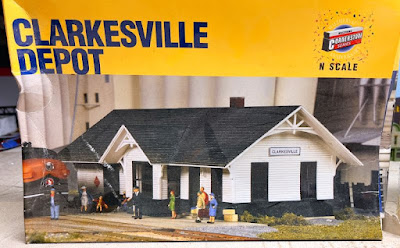
Tonight I figured I'd better make sure the depot would fit the same location where the stand in has been sitting.  So I dug out the Walthers Clarkesville depot and set the foundation in place, and it fits.  So the tracks won't have to move now.


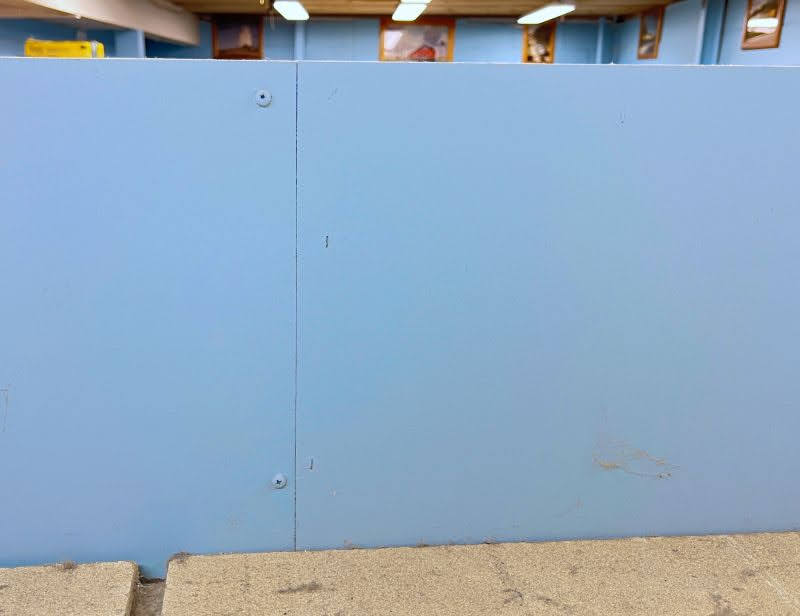
I started thinking about the Maytag building and where it would sit along the backdrop.  Well that got me thinking about the backdrop.  I should really get it done first?  That means I'll need to get it prepped and ready to paint so it look like this when I'm done.


So tonight I cleared things off and got a clean slate to work with.


The first task will be to remove the panhead screws I used to hold the backdrop in place and replace them with some #6 x 5/8" countersink screws, then patch them with spackling and repaint.  I'm also gonna have to do something with this seam?


Monday, April 28, 2014

Session #8 review


Another session is behind me and it went really well, thanks to everyone who attended.

Starting at 5pm seemed to work for most everyone this time as it only lasted till 8:30pm instead of 10 or 10:30 like we have in the past.  So I think we'll continue with this starting time.

I had hoped to drag the session out to about 4hrs this time by keeping the overall speeds of the trains down to 20-25 mph, trying to run on a simple schedule that would space them out a bit, which would give the El Dorado yard crew a much less rushed job.  For the most part it worked.  Doug had more than enough time to get his jobs completed, this also included setting out cars for the actual town of El Dorado.  At one point he actually had time to set the throttle down and walk around to see what else was happening on the layout.


Even with the problem of the locos running at a reduced speed from what I had them programmed to, wasn't very noticeable with the slower speeds.  So if I never figure out what's up with the programming, or should I say re-programming of the CV's, maybe it won't matter much.  On thing I've considered doing was to adjust the top speed of the locos to a higher setting and then if the CV's get re-programmed maybe they will run closer to what I prefer. So many things to try to track down with this, I might never get to the bottom of it.

The more and more I run the trains at a reduced speed, the more I like it.  While I was never one to run them at top speed anyways, to see them crawling along at slow speed does several things for me. 
1- It takes longer to get where you're going so it gives a feeling of a larger layout or longer run.
2- It also does not show some of the sharper curves that are on the layout.  The locos do not seem to lurch or swerve as bad either.
3- It also give one more time to work and not feel rushed, this applies when working the yard at El Dorado which Doug concurred with this session.

I also plan to continue working on the timetable I've been playing with.  Not so much for keep to a tight schedule, but more so for keeping the trains spaced out and not getting them so jumbled up.

Unfortunately since we only had 5 crews for the biggest share of the evening, it didn't leave me much time to get a lot of pictures or videos.  So I went back down Sunday afternoon and re-staged a few.

The only major mishaps we had Saturday night was with the SBD auto rack.  Greg, not being very familiar with things didn't know he had to throw the North turnout of the passing siding at El Dorado before leaving town. It resulted in the lead loco derailing and completely rolling off the tracks.  But he was a trooper! He just brushed himself off, crawled onto the second loco and kept going so he didn't louse up the schedule!  Since it wasn't fowling the mainline, a call was placed for the cleanup crew who arrived later and reclaimed the C30-7 without much problems.


As for the new maneuver at Ruston between the ICG and the Winnfield local, it worked out just as planned and I will place it on my list of things to do.  When I get a chance I will remove the two sidings and relay the junction with a single track.  Again, since I didn't have time to video the actual interchange during the session I re-staged it Sunday afternoon.  I apologize for the crappy video and the vertical format, but it was the only way I could shoot the entire scene.


The way I had this designed in the beginning was to have the ICG leave the it's staging a the start of each session and run out the junction and preform a run around with the cars that was left there from the previous session, then return to their staging.  The the Winnfield local would drop off their cars and grab what the ICG had left earlier.  This was a simple job which gave a newbie a chance to get their feet wet without becoming overwhelmed.  But now this gives a chance for both crews to interact and adds small challenge to keep things interesting.  Quin drew the Winnfield local and I drew the ICG job and it went off without a hitch.

I also want to thank DJ of DJsTrains for posting his video which I uploaded in a recent post that gave me the idea for the new maneuver at Ruston.
Thanks DJ!

With this session behind me and the weather warming up, I have a bunch of outside jobs to get after.  Once I can get a few them under control and the weather really warms up, my plans are to get back to working on the layout and get some of the buildings finished up in Malvern and start on a few other places so I'll have more than just Ceiling Tile Flats everywhere.


Wednesday, February 27, 2013

A closer look at Malvern

Since I'm starting to get the scenery going in Malvern I thought I would give you a detailed look and history of  Malvern.  It might make it easier to follow along rather than just reading about the town and industries.

Conception of Malvern

From the time I started thinking about building a layout I have always had it in mind that a layout would not be complete without some sort of branch line.  Be it a short piece of track to drop cars off  for an "Off-line" destination or a full blown town with industries to serve.  The area of the room that Malvern resides in lent itself very well for a branch line.   

History of the W&OV

While designing the layout, I knew I wanted to include the little short line called the W&OV [Warren and Ouachita Valley RR].  The road actually existed and connected to The Rock Island at  Banks, AR. 


They were basically a lumber hauler that was owned by the stockholders of the Arkansas Lumber Company and the Southern Lumber Company, both of which have mills on the line.  One of their locomotives was a 10 wheeler.


In 1948, the Rock Island purchased the Warren and Ouachita Valley Railway and assigned a Rock Island Whitcomb  75DE12c #1013.


Proving not to have enough power,  the little Whitcomb was replaced with a Rock Island EMD SW-1 #539


Disclaimer:
I borrowed all of the above photos from the internet and the information came from various sites as well.
The information may not be 100% correct, but it's close enough for my purposes

Since the original W&OV was purchased by The Rock 1948 that meant I had to re-write some more history.  So, in my history book in 1979 when The Rock started to shed their branch lines for capital, they sold some of these lines to a newly formed short line who re-used the original name; The W&OV.


Rewriting the History books

One thing that I enjoy about modeling is not only building a layout, but also trying to build a history as well.  To me this seems to make the layout a little more plausible.  So this is what I came up with;

 This was taken form my first post.

The re-written history (according to me)

In the early months of 1979 as bankruptcy was drawing near, The Rock started hauling the seafood North from the Gulf and actually made a small profit from doing this, but they needed more capitol.  They decided to start shaving off the mainline, down to the bare minimum and sold off two portions of the line to the newly formed W&OV.

The first section to be sold off was the original line that the original W&OV had operated: Banks to Warren and the remaining section that connected to Tinnsman Jct.  The second section was the branch that started at Haskell, AR and ran West to Hot Springs, AR and South to Sparkman, AR.
After the purchase of these two separate sections, the newly formed W&OV moved their headquarters to the northern section and setup shop at Malvern, AR. They also received trackage rights to run between these two lines and interchange with The Rock at El Dorado, AR with a train they nicknamed The Razorback.


Designing Malvern

With the history all re-written, it was time to start getting a track plan that would fit in the area I had to work with but nothing overly complicated.  I wanted several industries that could be found in the South as well as any small town USA.  I also based these industries on some of the rolling stock that I had and wanted to use; tank cars, wood chip hoppers, pulpwood flats, coiled steel cars, bulkhead flats, gondolas and open hoppers.

The first was a chemical plant which are common in the South.  This would become Olin Corp, a company that would produce Hydrochloric acid that would ship and receive tank cars.

The next would be a forest product based industry, I chose a pulpwood plant that received loaded pulpwood flats and shipped out loaded woodchips; Crushmoore Ind. 

For use of coil cars, bulkhead flats and gondolas I had the Walthers Vulcan Mfg kit, this would become Heavy Metal Ind, fabricators of steel products.  They would receive loaded coil cars, bulkhead flat and gondolas of steel.

I also wanted a quarry [modeled as siding] that used hoppers to supply an online cement company in Dubach, LA with aggregate. These hoppers would be captive service cars that would never return to the main yard.

The last three were industries that could be found in any small town USA; 
An LPG dealership; Frump Gas & Supplies.  They would receive loaded LPG tanks.
An implement dealership; McClehaney Equip. Co. Loaded flat cars and boxcars with implements and supplies.
The last one is a paper recycling company [further down the line, also modeled as a siding as well].  Empty boxcars would be delivered and loaded with bails of paper and cardboard.

Now, knowing what industries I wanted and what types of cars to use, it was time to get the track plan worked out.   As I said earlier I wanted something simple so I based it off  a single track main with at least one siding, something most small towns would have.  This would allow me the ability to make "run around" moves so as to access all the spurs which would be facing both in directions. 

The W&OV track is in purple.


Once I got the track in place I could now figure the max amount cars for each siding/industry.   To make sure I had enough room to work, I made the siding in Malvern as long as I could get it,  better too much than not enough.

Operations of  The Rock

The Little Rock Line has two daily locals that originate out of El Dorado yard. The Haskell turn [North bound] and the Winnfield turn [South bound].  Each turn originates at and returns to El Dorado.  Having decided to run the locals as "out and back" runs from El Dorado, I needed at least one siding at Haskell and one siding at Winnfield to accomplish this. 

The Haskell turn

In my original design I had planned for a full Wye and one siding at Haskell, this would allow me to turn the locos and run around the train via the Wye.  After running a few trains in my head I decided to forgo the full Wye and make one leg a stub ended siding and model it as removed, which I thought would add a little more visual interest to the scene.  I designed Haskell with one siding that connected to the remaining leg of the Wye leading to Malvern.  This would still leave me with a "run around" ability, but would require the Rock Island locomotives to travel on some of the W&OV trackage.  So an agreement was struck for this movement.

In the process of laying the track I had a thought that it might be nice to have a second shorter siding at Haskell for extra room if needed.  This turned out to be a good idea as the W&OV also needed to serve McClehaney Equipment and could slip by anything setting in the main siding.  This also proved to served as an optional Arrival or Departure track for the W&OV if needed.

Originally I had planned to have the Haskell turn deliver cars to the W&OV, but it was nixed after we ran the first test session.  The Haskell turn had way too many cars and it took forever to switch out the cars for Riceland, McClehaney's and the cars for the W&OV.

Now, after the Haskell turn works the line north to Haskell, it pulls into the siding, runs around it's train and works the Riceland plant, then heads back to El Dorado working any trailing point industries on the return trip.  The amount of work and time was reduced to a much more manageable task within the set hours of the ops session by not having to deliver cars to the W&OV.

The W&OV

This is where the fun begins.  Since The Rock no longer delivered to the The W&OV, they would become responsible to get the cars themselves.  This would required the W&OV to travel over Rock Island rails to El Dorado to deliver and exchange cars.  Not only did this give the W&OV crew another job to work, it also added to the traffic on the north end of the line.

Operations of the W&OV

A two man crew can be assigned to the W&OV during any operating session.  After receiving their Wheel Report and seeing what cars are bound for Malvern, their first task is to use the local switcher to gather the appropriate cars from the industries in Malvern to make room for the inbound cars.  Once these cars have been gathered up and the road power is tied onto the Razorback [The W&OV's daily train to El Dorado], they ask for permission to make the run to El Dorado.
Upon returning to Malvern, the power and caboose is cut off the Razorback, and is taken to the house.  The crew then grabs the local switcher and begins the task of delivering the newly arrived cars to their respective industries that is spelled out on the Wheel Report.   
Once this is done, their job is finished for the session.

Power for the W&OV

Having to retrieve their own cars also required a purchase of some road power and a caboose to go along with the Malvern switcher.

I had first planned to use a couple of ex-CR SD9's [one of which can be seen in the previous post] but after some careful consideration, the management, that being ME, began to look at some second hand ALCo power.  Eventually the 2 SD's will be traded for 3 four axle ALCo units;  2- C420's  and 1- RS11.  One of the newly announced Atlas S-2's will be the local switcher when they arrive.

Nothing better than solid ALCo power!

I hope this give some of you a better understanding and insight of Malvern and how it plays a roll on The Little Rock Line?